Climate-Resilient Paddy & OFC Programme
Drought-tolerant varieties, tank cascade rehabilitation, weather-indexed crop insurance.
Summary
Eastern Province grows about a fifth of Sri Lanka's paddy. It does it in a dry zone that is getting drier in some seasons and more flood-prone in others. This five-year programme works on the things that buffer that volatility: drought-tolerant varieties, restored minor-tank cascades, weather-indexed crop insurance that actually pays out, and farmer field schools that teach the techniques rather than hand out the inputs.
15,000 farming households across Ampara, Batticaloa interior, and the Mahaweli-tail GN divisions. Forty minor tanks in the Maduru Oya and Gal Oya cascades restored. Three drought-tolerant rice varieties pushed through to commercial seed production. Index insurance backed by a regional re-insurer, with claim triggers tied to satellite rainfall data — paid out without farmers needing to file paper claims.
The problem on the ground
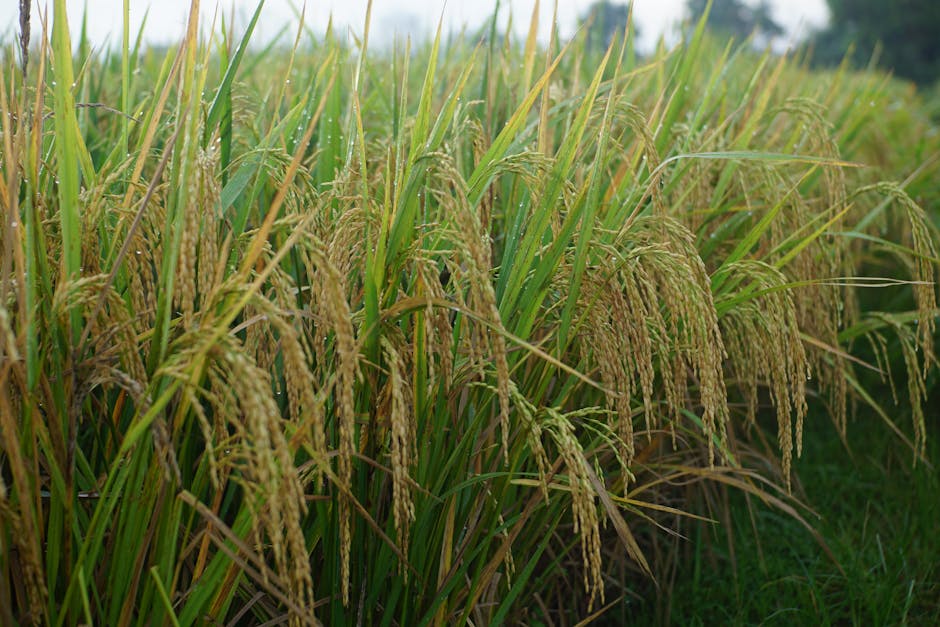
Maha-season paddy in the East depends on the second inter-monsoon rainfall, October-December. When that fails — which it has in two of the last six years — the standard BG-300 series suffers 40-60% yield loss. There are short-duration, drought-tolerant varieties (Bg 366, At 308) sitting in the Department of Agriculture's seed pipeline that don't reach Eastern farmers reliably because the formal seed-multiplication system runs at low capacity and the informal seed system reproduces whatever the previous season's market preferred.
The minor-tank cascade — those small, interconnected village reservoirs that buffer dry-season water and recharge groundwater — has degraded across most of the East. Sediment, broken sluices, abandoned channel networks. Restoring them is unglamorous, it doesn't make a good ribbon-cutting, but it's the most cost-effective climate adaptation per hectare in dry-zone Sri Lanka.
Crop insurance technically exists. In practice, almost nobody who needs it has it, because the claim process is too complex and the payout history is too uncertain. Farmers don't trust the product, and they're right not to.
What the project actually does
Three workstreams that have to happen together.
Seed and variety: pull Bg 366 and At 308 (and one OFC variety, Mungbean MI 6) through the formal seed-production pipeline by paying for the multiplication at a registered seed-paddy farm in Ampara. Distribute through 250 farmer-field-schools, not free hand-outs.
Minor-tank cascades: 40 minor tanks restored in the Maduru Oya and Gal Oya feeder networks. Standard package — desilting, sluice repair, bund stabilisation, encroachment removal where it's done with FPIC. Each cascade gets a farmer organisation reactivated to manage downstream water rotation.
Insurance: a weather-indexed product (rainfall-deficit trigger on satellite data) co-designed with a regional re-insurer. Premium subsidised at 60% in Y1 stepping down to zero by Y5. Pay-out automatic, not application-based, transferred directly to mobile money accounts.
Farmer field schools as the delivery rail for all three — 250 schools, 60 farmers each, season-long curriculum.
Market & demand
Paddy doesn't have a market problem. Sri Lanka consumes what it produces, and net imports of about 200,000 t a year mean any productivity gain finds buyers immediately. The Paddy Marketing Board provides a price floor that — while imperfectly enforced — exists.
What the project does shift is the income variability. A farmer growing BG-300 with no insurance in a drought year earns 35-50% of a normal year. A farmer growing Bg 366 with index insurance earns 75-85% of a normal year. The mean income may be similar; the standard deviation drops dramatically. For households at the poverty line that variability is the binding constraint, not the mean.
OFC market is more interesting. Green gram, black gram and sesame all command export-grade prices when graded properly. Contract farming with three named processors (one in Polonnaruwa, two in Colombo) is in place.
Who benefits, and how
15,000 paddy households across 250 GN divisions in Ampara, interior Batticaloa, and the Mahaweli-tail divisions. Ethnically representative of the underlying paddy belt — 41% Tamil, 38% Sinhala, 21% Muslim — though weighted more heavily Sinhala in the Mahaweli-H zone and more heavily Tamil in interior Batticaloa.
Second-order beneficiaries: 40 farmer organisations reactivated for tank cascade management (~600 office-holder farmers). Seed-paddy farm operators (30 households) earning from variety multiplication.
Third-order: 80 lower-cascade households whose drinking-water wells recover yield because the upper-cascade tank is buffering again.
Impact across 20 lenses
Every project on this site is scored against the same 20 lenses. For each one we say how the project moves the needle, not just whether it does.
01. Rural Development
Core · 3/315,000 paddy households across 250 GN divisions get drought-resilient seed, restored irrigation cascades and working insurance.
03. Poverty Reduction
Core · 3/3Income variability cut sharply — drought-year income rises from 35-50% to 75-85% of normal-year baseline.
04. Employment Generation
Direct · 2/330 seed-paddy farm jobs, 600 farmer-organisation officers reactivated, 80 cascade-management positions.
05. Environmental Sustainability (ESG)
Direct · 2/3Wetland habitat recovery in restored cascades; pesticide-reduction module in every farmer field school.
06. Climate Change Adaptation
Core · 3/340 minor tanks restored, 3 drought-tolerant varieties commercialised, index insurance backstopping 15,000 HH against rainfall failure.
07. Economic Development & SME Growth
Indirect · 1/310. Capacity Building & Skills Development
Core · 3/3250 farmer field schools × 60 farmers = 15,000 trained over the programme. 600 FO officers re-trained.
11. Public–Private Partnerships (PPP)
Direct · 2/3DoA + Mahaweli + Agriculture Insurance Board + regional re-insurer + mobile-money operator + satellite-data provider.
12. Social Inclusion
Direct · 2/341/38/21 ethnic mix preserved across implementation. Farmer organisations rebuilt with women-quorum requirement.
13. Infrastructure Development
Core · 3/340 minor tanks, 1 seed-paddy multiplication unit, 250 farmer-school sites.
14. Financial Sustainability & Revenue Model
Direct · 2/3Insurance moves to zero-subsidy by Y5; seed system self-funding by Y2; cascade rehab is one-time public infrastructure.
15. Measurable Impact (KPIs & Outcomes)
Core · 3/31,500-HH HIES-comparable panel; yield baselines per 250 FFS; insurance payout audit trail.
16. Alignment with Donor Priorities
Direct · 2/3Strong climate-adaptation, food-security and rural-livelihood fit. Gender lens moderate — pair with a women-led flagship.
17. Scalability & Replicability
Core · 3/3Tank rehab replicable to 14,000 minor tanks nationally. Index insurance, once de-risked, replicates to other dry zones.
18. Risk Assessment & Mitigation
Core · 3/3Insurance is itself the principal risk-mitigation instrument. Multi-variety strategy hedges single-variety failure. Cascade buffer hedges within-season drought.
20. Community Impact & Social Value
Core · 3/380 lower-cascade HH see drinking-water well recovery as ecosystem co-benefit.
KPIs & targets
Financial model & sustainability
This is a public-good project. The minor tank restoration and farmer field school work do not have a commercial revenue model — they are public infrastructure and extension services, paid for by the grant.
The insurance product is structurally different: it must be commercially viable by Y5 or it doesn't survive. The premium-subsidy taper (60% in Y1 to 0% in Y5) is the model. The re-insurance partner has agreed to operate it provided enrolment crosses 8,000 farmers by Y3.
Seed production is a self-sustaining sub-system from Y2 — the seed-paddy farm sells certified seed at a 15% premium over commodity paddy, which covers its operating cost. The project subsidises only the initial variety transfer and quality certification.
Innovation & technology
Index insurance with satellite triggers is the headline innovation. Not new globally — operates in Kenya, India, parts of Sahel — but new at scale in Sri Lanka. The pre-tested triggers are: cumulative rainfall deficit below threshold in October-December (Maha) and April-May (Yala), measured at 5 km grid resolution.
The rest of the project is deliberately low-tech: seed varieties already exist, tank engineering is well-understood, farmer field schools have been around for 30 years. The innovation is the bundle.
Partners & implementation
Public: Department of Agriculture (variety transfer, extension), Mahaweli Authority (tank cascade engineering), Irrigation Department, Sri Lanka Agricultural Insurance Board (regulatory partner), Department of Meteorology (data feed).
Private: a regional re-insurer (named, in early discussions), three OFC processors as off-take partners, mobile-money operator for payout delivery, satellite-data provider.
Community: 40 farmer organisations as the operational nodes; 250 farmer field school groups.
Monitoring, evaluation & learning
Three things measured: yield per hectare (sample plots across the 250 farmer field schools, season by season), income variability (HIES-comparable income tracking on a 1,500-household panel), insurance uptake and payout history (the public-trust signal). Tank cascade rehabilitation is measured by command area irrigated and downstream groundwater recovery.
Mid-term Y3, final Y5, follow-up Y7.
ESG safeguards
Environmental: cascade restoration recovers wetland habitat (tanks are critical for migratory bird populations in the dry zone). Variety choice favours water-efficient cultivars. No expansion of paddy area into ecologically sensitive land. Pesticide-reduction module embedded in farmer field school curriculum.
Social: tank encroachment removal — where required — is done with FPIC and alternative-livelihood provision, not by force. Farmer organisations rebuilt with explicit women-quorum requirements where they were historically men-only.
Governance: insurance product subject to insurance regulator oversight; satellite trigger and payout data published openly.
Donor alignment
Climate adaptation in dry-land agriculture is one of the standard donor priority slots, including for Canada. The gender component is moderate (women are involved but not the project's centre of gravity), so this is best paired with another flagship from this portfolio to balance the donor's gender lens. Food-security and rural-livelihood lenses are strong.
Risks & mitigation
| Category | Risk | L | I | Mitigation |
|---|---|---|---|---|
| Climate | Drought / flood / cyclone disrupting implementation | 4 | 4 | Index insurance buffers downside of catastrophic Maha failure. Variety diversification across Bg 366, At 308 and traditional varieties hedges single-failure risk. |
| Political | Change in Provincial Council or line ministry priorities | 3 | 3 | Tank rehabilitation done in coordination with Mahaweli + Provincial Council. No FPIC-violating encroachment removal. |
| Operational | Implementing-partner capacity gap | 3 | 3 | Re-insurer enrolment threshold (8,000 by Y3) is the binding success criterion — mid-term review will refresh marketing if uptake lags. |
Scalability & replication
Minor-tank restoration is endlessly replicable — Sri Lanka has roughly 14,000 minor tanks and most need work. The cascade management model is portable.
The insurance product, once at scale, replicates nationally. The hardest part — building re-insurer confidence in the satellite-trigger product through three full seasons of clean payouts — is exactly what this project funds.
The seed-variety pipeline is the slowest piece to scale. Each new variety needs 3-4 seasons of multiplication before it's commercially available. Worth funding the pipeline even though it doesn't move headline beneficiary numbers.
Gallery