Batticaloa-Trincomalee Mangrove Restoration & Blue Carbon
600 ha mangrove restoration with women-led nurseries and blue-carbon revenue.
Summary
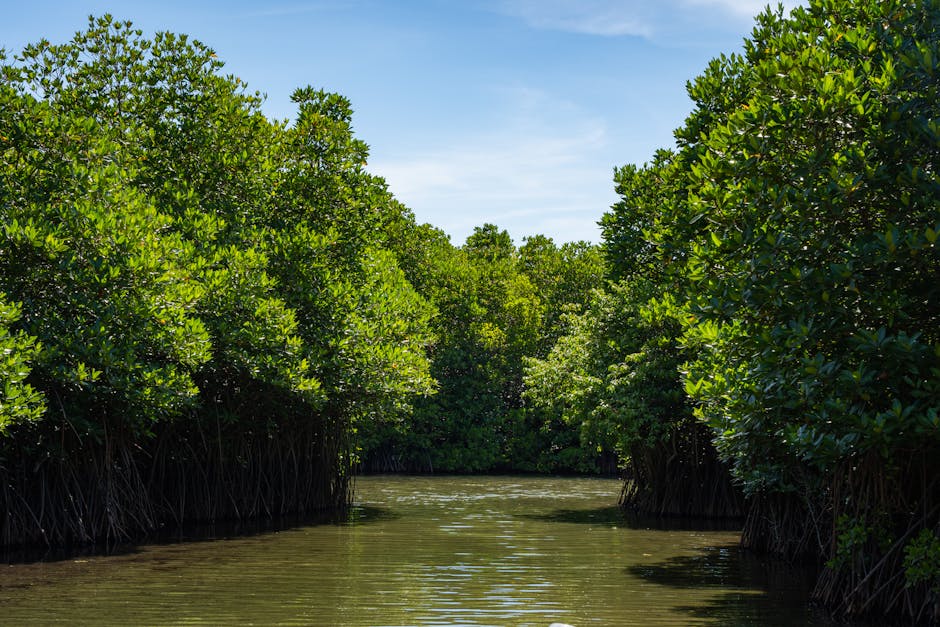
Six hundred hectares of mangrove. Forty-five villages. Two lagoons. One verified blue-carbon revenue stream returning to the people who actually do the restoration work.
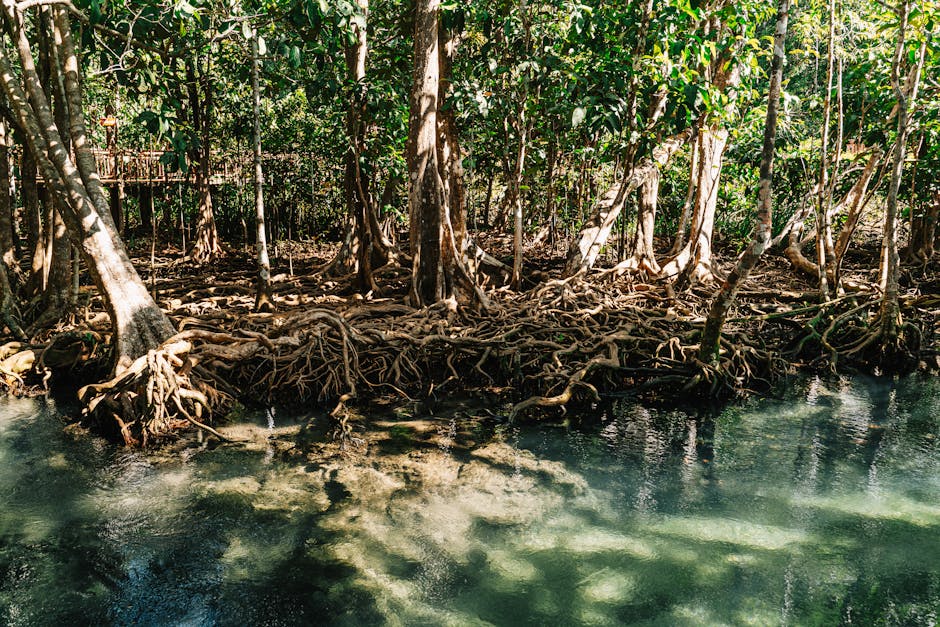
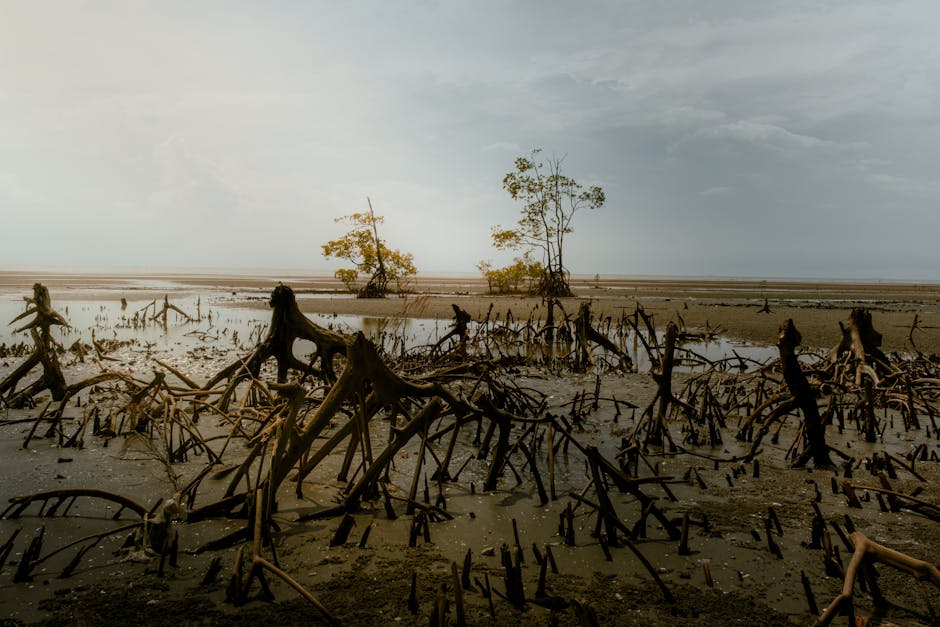
Sri Lanka has lost about 50% of its mangrove cover since the 1980s — to shrimp farming in the West, to clearance and reclamation in the East, to upstream pollution everywhere. The East lost particularly heavily because Batticaloa and Upparu lagoon mangrove was cleared for short-lived prawn pond expansion that has since mostly collapsed. The land is degraded, the lagoon ecosystems are diminished, and the people who depended on them are poorer.
This programme restores 600 hectares with women-led community nurseries, registers the project under a verified carbon standard (Verra or Plan Vivo, decision pending verifier feedback), and channels the carbon revenue through community benefit-sharing agreements rather than disappearing it into project overhead.
The problem on the ground
Stand in Vakarai facing the lagoon at low tide. You can see where the mangrove was: low mounds, stumps, occasional regrowth. The shrimp ponds that replaced it have mostly failed — disease, salinity collapse, abandoned dykes. The land is in a no-mangrove, no-pond, no-farm limbo, generating nothing for anyone.
Restoration is technically straightforward — propagule planting in the right tidal zone, three-year survival monitoring, no big infrastructure required. The barrier is who pays for the labour during the years before the ecosystem services materialise, and who captures the value when they do. Without a revenue model that returns value to the restoration community, restoration projects fail at the seven-year mark when external attention moves on.
The blue-carbon market is real. Verra and Plan Vivo standards both certify mangrove restoration projects. Prices range USD 8-30 per verified tonne of CO₂e depending on co-benefit credentials. The work to register, monitor and sell credits is itself a project — and a profitable one if community share is structured right.
What the project actually does
Five-year project, three phases.
Phase 1 — Site selection and community engagement (Y1): 60 candidate sites mapped across Batticaloa and Upparu lagoons; 45 selected after FPIC and lagoon-committee consultation. Site selection criteria: ecological suitability, tenure clarity, community demand, accessibility.
Phase 2 — Restoration (Y1-Y3): 600 ha planted in three seasons. Women-led nurseries (12 nurseries, ~50 women each) produce propagules and contract with the project on per-stem basis. Community labour for planting paid at MGNREGA-equivalent daily rate. Three-year survival monitoring built into payment cycle.
Phase 3 — Carbon and co-benefit revenue (Y3-Y5 onwards): Verra (or Plan Vivo) registration completed by Y3. First credit issuance Y4. Revenue split: 60% to community benefit-sharing trust, 20% to ongoing monitoring and protection, 15% to apex programme operations, 5% to verification cost.
Co-benefit revenue streams: mangrove honey (60 beekeeping households as a separate pitch in this cluster), eco-tourism kayak operations (community-owned), and small-scale crab-fattening pilots in restored fringe zones.
Market & demand
Blue-carbon credit pricing has been volatile but is structurally rising. The current Verra mangrove credit price band sits around USD 14-22 per tonne CO₂e, with co-benefit-certified credits at the upper end. Mangrove sequesters roughly 6-8 tCO₂e per hectare per year above ground, more in soil — call it 10 tCO₂e/ha/yr conservatively for project-area conditions.
600 ha × 10 tCO₂e × USD 16/credit = USD 96,000/year of carbon revenue at steady state. Plus mangrove honey (~USD 18,000/yr), eco-tourism (~USD 25,000/yr at maturity), and crab pilots (~USD 30,000/yr).
The market caveat: credit-buyer demand is concentrated among corporate net-zero programmes; the secondary market is thin; verification rules tighten periodically. The project's blue-carbon revenue is not a guarantee, which is why co-benefit streams are deliberately built in as parallel revenue.
Who benefits, and how
Direct: 45 villages, ~3,200 households across coastal Batticaloa and Trincomalee. Predominantly Tamil with significant Muslim minority in Upparu cluster. War-affected and displacement-history communities heavily represented — this is the demographic that lost mangrove access in the 1990s and 2000s.
Women specifically: 12 nurseries, ~600 women total in propagule production and nursery operations. Mangrove-honey co-op: 60 households (women-led).
Indirect: lagoon-dependent fishing households (~2,800) gaining from rebuilt nursery habitat for prawn and finfish.
Impact across 20 lenses
Every project on this site is scored against the same 20 lenses. For each one we say how the project moves the needle, not just whether it does.
01. Rural Development
Core · 3/345 coastal villages and ~3,200 HH organise around restored ecosystem; lagoon fisheries and honey/tourism income return.
02. Women Empowerment
Direct · 2/312 women-led nurseries employing ~600 women; 60-HH mangrove-honey co-op (women-led).
03. Poverty Reduction
Direct · 2/3Carbon-revenue distribution + ecosystem-services co-benefits lift average HH income by ~USD 280/yr by Y5.
04. Employment Generation
Direct · 2/3~660 women in nurseries + 60 beekeeping HH + 24 kayak-tourism operators + 30 crab-pilot operators.
05. Environmental Sustainability (ESG)
Core · 3/3600 ha mangrove restored; lagoon water quality and fishery nursery habitat rebuilt. The project IS the ESG outcome.
06. Climate Change Adaptation
Core · 3/3Mangrove buffer reduces storm-surge damage in 45 coastal villages; lagoon resilience to salinity shifts improves.
07. Economic Development & SME Growth
Direct · 2/3Mangrove honey co-op, kayak-tourism co-op, crab-fattening pilot — 3 new community enterprises with revenue.
09. Technology & Innovation Integration
Direct · 2/3Per-stem-survival-linked payment system; drone-imagery monitoring; satellite carbon-accounting.
10. Capacity Building & Skills Development
Direct · 2/3600 women trained in propagule production and nursery management; lagoon committees trained in stewardship.
11. Public–Private Partnerships (PPP)
Core · 3/3Forest Conservation + Wildlife + Coast Conservation + Verra body + corporate net-zero buyer + honey processor.
12. Social Inclusion
Core · 3/3War-affected displacement-history communities are the project beneficiary group. Tamil-Muslim mix preserved.
14. Financial Sustainability & Revenue Model
Core · 3/3Self-financing from Y4 through carbon + honey + tourism + crab combined revenue (~USD 169k/yr).
15. Measurable Impact (KPIs & Outcomes)
Core · 3/3IPCC/Verra carbon accounting; drone-imagery survival monitoring; community-trust accounts published openly.
16. Alignment with Donor Priorities
Core · 3/3NbS + climate + gender + inclusive growth — strong fit with multiple climate finance windows.
17. Scalability & Replicability
Core · 3/3Restoration model + community-trust template open-licensable. Pipeline of 5,000+ ha replication-ready around the country.
19. Innovation & Competitive Advantage
Core · 3/3First at-scale community-anchored blue-carbon project in Sri Lanka, with verifiable revenue returning to restoration community.
20. Community Impact & Social Value
Core · 3/3Community-trust funds village priorities (schools, wells, infrastructure) chosen by lagoon committee — not by project.
KPIs & targets
Financial model & sustainability
Grant funding pays for restoration, monitoring infrastructure and verification cost through Y3.
From Y4 onwards the project is intended to be self-financing through:
- Blue-carbon credit sales (~USD 96k/yr at steady state)
- Mangrove honey co-op (~USD 18k/yr)
- Eco-tourism kayak operations (~USD 25k/yr)
- Crab-fattening pilots (~USD 30k/yr)
Total ~USD 169k/year by Y5 covering monitoring, protection, community-trust contributions, and apex operations. The 60% community-trust share funds village-level priorities (schools, wells, small infrastructure) selected by lagoon committees.
Innovation & technology
Mangrove restoration is ancient. Blue-carbon finance is new in Sri Lankan context. The combination — community-anchored restoration with verifiable carbon revenue returning to the community — has been done globally in maybe twenty places. This would be the first at scale in Sri Lanka.
The specific innovation: per-stem-survival-linked payments (not per-stem-planted), which removes the perverse incentive to plant in unsuitable conditions just to hit a number.
Partners & implementation
Public: Department of Forest Conservation (project anchor), Department of Wildlife Conservation, Coast Conservation Department, Provincial Council Eastern, Ministry of Environment (NDC alignment).
Private: a Verra-accredited validation/verification body (named, in early engagement), a corporate net-zero credit buyer aggregator (named), and a mangrove-honey processor in Colombo as off-take for the co-op product.
Community: 18 lagoon co-management committees, 12 women's nursery cooperatives, 1 community-trust holding apex structure.
Monitoring, evaluation & learning
Mangrove survival rate measured per site, season by season, with drone imagery and ground-truth quadrats. Standardised carbon accounting following IPCC and Verra methodology. Co-benefit indicators tracked separately: honey yield, kayak-tourism revenue, crab pilot harvest.
Independent biennial verification of carbon claims. Mid-term Y3, final Y5, long-term Y10 ecosystem evaluation.
ESG safeguards
Environmental: the project is environmental restoration. Mangrove sequesters carbon, buffers storm surge, hosts juvenile prawn and fish stocks, filters lagoon pollution. There is no down-side to doing it well — and significant risks if done poorly (planting wrong species in wrong zones is the typical failure).
Social: FPIC at site level, full transparency on carbon revenue and community-trust allocation, independent community grievance mechanism, war-affected displacement claims respected.
Governance: community-trust constitution requires open accounts, lagoon-committee oversight, and a two-thirds vote for any allocation above LKR 500k.
Donor alignment
Sits at the centre of climate finance plus nature-based solutions plus inclusive growth — strong fit for Canada's climate and biodiversity priorities and for FCDO blue-economy windows. The community-trust governance speaks directly to feminist/inclusive donor lenses.
Risks & mitigation
| Category | Risk | L | I | Mitigation |
|---|---|---|---|---|
| Climate | Drought / flood / cyclone disrupting implementation | 3 | 3 | Species selection and tidal-zone matching prevent the typical restoration failure pattern. Survival-linked payments incentivise correct planting. |
| Market | Off-take buyer withdraws or price collapse | 4 | 3 | Carbon-price volatility hedged through forward off-take with corporate buyer aggregator; co-benefit revenue streams parallel-funded. |
| Land | Land tenure disputes blocking infrastructure siting | 3 | 4 | Tenure verification at every site; abandoned shrimp-pond land has complex history but most parcels are state-held coastal reservation. |
| Reputational | Donor concerns over governance, fraud or human rights | 2 | 5 | Independent verification of community-trust allocation; full transparency on credit sales and revenue distribution. |
Scalability & replication
Mangrove restoration scales straightforwardly along the Sri Lankan coast — Mannar, Puttalam, Negombo lagoon, Hambantota wetlands all need similar work. The blue-carbon registration framework, once set up for the East, is portable.
What doesn't scale linearly is the community-trust governance model. Each lagoon has different displacement histories, different traditional fishing rights, different political dynamics. Replication requires social mapping every time.
Gallery